

Advanced eCommerce analytics – which data really shows your store’s profitability?
CEO & IT Architect
Step 1 of 2
Let's talk about what you need
Tell us about your idea or project. Focus on business and leave the technology with us.
Nie lubisz formularzy? Zadzwoń!
62 727 23 90
CEO & IT Architect
The number of orders, revenue, and conversion rate are basic metrics tracked by almost every online store. The problem is that on their own, they tell you very little about whether your sales are actually profitable. This is why well-planned eCommerce analytics should cover much more than basic sales metrics.
An online store can generate high traffic, increasing revenue, and a strong-looking ROAS (Return on Ad Spend), while still losing money on some orders. It can also invest heavily in acquiring users who visit the website but never become customers.
That is why deeper data analysis needs to go far beyond standard sales reporting. Only by combining information about traffic, sales, margins, acquisition costs, and order fulfillment costs can you see where your store actually makes money and where it is simply generating revenue.
Conversion rate shows what percentage of users visiting your store complete a purchase. It is an important metric, but when analyzed without a broader context, it can lead to oversimplified conclusions.
A much more interesting question is: how much real value does the traffic coming to your store generate?
You may have a million users visiting your website every month, but if most of them are not interested in your product range, high traffic alone has little business value. What is more, acquiring that traffic costs money, while handling larger volumes of visitors can also increase the infrastructure requirements of your store.
On the other hand, a smaller but highly relevant audience can generate significant sales.
That is why you should analyze not only the number of visitors, but above all traffic quality and how effectively it translates into sales.
One of the most important elements of advanced analytics is segmentation. The more precisely you divide your data, the easier it becomes to identify which areas of the business are actually generating value.
Data can be analyzed by, among other things:
For example, you may discover that out of a thousand products, only 20% generate the majority of your sales. In that case, these products may deserve particular attention in your marketing activities.
Similarly, it is worth analyzing sales from Google Ads, social media, organic traffic, and other acquisition sources separately.
The deeper the segmentation, the lower the risk of making decisions based on averages that hide important differences.
A single order does not always reflect the true value of a customer.
Let us assume that acquiring a customer costs PLN 70 and their first order is worth PLN 100. At first glance, the relationship between acquisition cost and sales value may not look particularly attractive.
However, if the same customer returns during the year and spends another PLN 300, their total value increases to PLN 400.
That is why it is worth analyzing Customer Lifetime Value, which shows the value a customer generates over a given period of time.
This is particularly important for businesses where customers make regular purchases. An acquisition campaign may look unattractive after the first transaction, but turn out to be highly profitable if a significant percentage of acquired customers return to make further purchases.
ROAS shows the relationship between advertising spend and the revenue generated. The problem is that it does not take into account many of the costs associated with fulfilling a particular sale.
Products can have different margins, and their logistics costs can also vary significantly.
Packing a small parcel requires a different amount of work than preparing a large pallet order. In the latter case, additional costs may include:
That is why profitability analysis should take into account not only advertising costs and sales value, but also product margins and the actual costs of fulfilling an order.
The most detailed analytical model can go all the way down to the level of an individual transaction and show how much the company actually earned on that particular order.
This is one of the metrics online stores often overlook.
If processing and fulfilling an order costs the company a certain amount, it is possible to calculate the minimum order value at which the transaction becomes profitable.
For example, if the costs associated with fulfilling an order amount to PLN 50 and the margin means that the store only starts making a profit once the order value reaches PLN 200, processing orders worth PLN 150 may result in a real loss.
To calculate this properly, you need to combine:
Only then can you determine the actual profitability of your sales.
Reducing a price is not a strategy in itself. Every promotion should have a specific business objective.
For example, it may be designed to:
That is why the effectiveness of a promotion should not be evaluated solely by the number of discounted products sold.
If a discounted product encourages a customer to add other items to their cart, the primary effect of the promotion may actually be an increase in the total order value.
There are advanced Business Intelligence systems available on the market, but for small and medium-sized online stores, their cost may be disproportionate to the scale of the business.
An alternative is to build a custom analytics model that collects information from several different sources.
A single database can include, for example:
Data connectors can play a key role here, allowing information to be retrieved from different systems and combined within a single analytical model.
However, there is no universal solution that works for every eCommerce business. The analytics model should reflect the company’s cost structure, product range, and business model.
Sales analytics does not have to stop at evaluating what has already happened in your store.
Companies that regularly replenish inventory should also analyze the seasonality of individual product groups.
Garden products, for example, will follow a very different sales pattern from Christmas decorations.
Historical sales data can therefore support decisions about when to order the next batch of products and how much stock to purchase.
Advanced eCommerce analytics is not about adding more charts to a dashboard. Its purpose is to answer a much more important question:
where does your store actually make money, and where does it simply generate revenue?
Only by combining information about sales, acquisition costs, margins, logistics, returns, traffic sources, and customer value can you see the true financial health of the business.
The most important point is that such an analytics model should be designed individually. A B2B wholesaler will need to focus on different data than a retail store, while a business operating across several markets may require yet another analytical approach.

CEO & IT Architect
Piotr Szeliga has over 15 years of experience in the e-commerce sector. He’s passionate about technology and new solutions. For years, he has been helping companies to become technological leaders in their industry.
Custom PrestaShop modules by Tebim – solutions that extend your store's capabilities
How to Choose an eCommerce Platform for a Mid-Sized or Large Business: PrestaShop Compared
PrestaShop ERP and WMS Integrations – How to Automate Sales in a Large Online Store?
PrestaShop implementation pricing – why do agency quotes differ?

Logging in as a Customer in PrestaShop – What Is Impersonation and When Is It Worth Implementing?

WhatsApp in eCommerce – Promotions, Order Status Updates, and Customer Communication

How much does it cost to maintain and develop a PrestaShop store? Hidden costs after launch

n8n Automations in eCommerce – How to Improve Your Store?

Advanced eCommerce analytics – which data really shows your store’s profitability?

Building a B2B Store on PrestaShop – Key Features for Wholesale Sales

Custom eCommerce store development – when is it worth investing in a dedicated PrestaShop solution?

How to minimize eCommerce store downtime during a platform migration?

How Much Does It Cost to Switch eCommerce Platforms? A Cost Guide for Online Stores

Where to find inspiration for your online store’s visual design?

How to migrate an eCommerce store: step-by-step process, checklist, and best practices

How to prepare for an eCommerce platform migration

Client Needs Analysis in an Online Store Project

What is remarketing, and how do you implement it in an online store?

Store Migration: Payments, Integrations, and Logistics
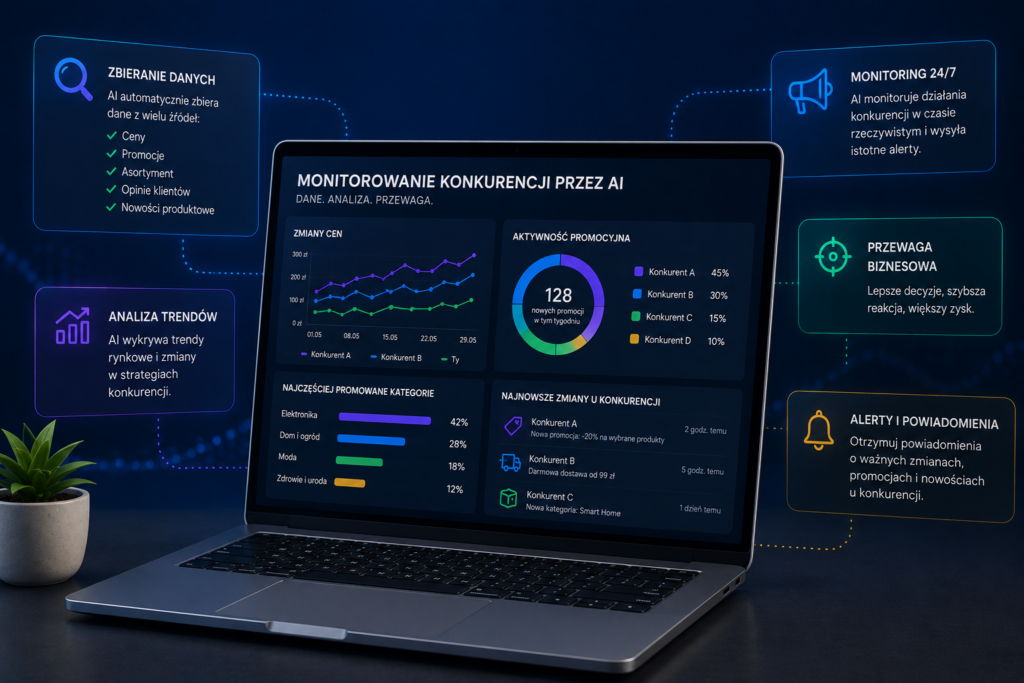
AI-Powered Competitor Monitoring — How Online Stores Analyze Prices, Promotions, and Market Trends
Custom PrestaShop modules by Tebim – solutions that extend your store's capabilities
How to Choose an eCommerce Platform for a Mid-Sized or Large Business: PrestaShop Compared
PrestaShop ERP and WMS Integrations – How to Automate Sales in a Large Online Store?
PrestaShop implementation pricing – why do agency quotes differ?
Logging in as a Customer in PrestaShop – What Is Impersonation and When Is It Worth Implementing?
WhatsApp in eCommerce – Promotions, Order Status Updates, and Customer Communication
How much does it cost to maintain and develop a PrestaShop store? Hidden costs after launch
n8n Automations in eCommerce – How to Improve Your Store?
Building a B2B Store on PrestaShop – Key Features for Wholesale Sales
How to minimize eCommerce store downtime during a platform migration?
How Much Does It Cost to Switch eCommerce Platforms? A Cost Guide for Online Stores
Where to find inspiration for your online store’s visual design?
How to migrate an eCommerce store: step-by-step process, checklist, and best practices
How to prepare for an eCommerce platform migration
What is remarketing, and how do you implement it in an online store?
Store Migration: Payments, Integrations, and Logistics
AI-Powered Competitor Monitoring — How Online Stores Analyze Prices, Promotions, and Market Trends

How to plan logistics and warehousing for an online store?

How to Reduce Order Fulfillment Costs in an Online Store: 10 Ways to Optimize eCommerce

Directive 2023/2673: The Return Button in eCommerce — How to Adapt Your Store and Avoid Penalties